Wednesday, April 19, 2017
'Making My Drawing PIRATE RADIO EDIT' in Strathmore Artist Papers' Spring Newsletter
Tuesday, May 21, 2013
Stop Trying Again
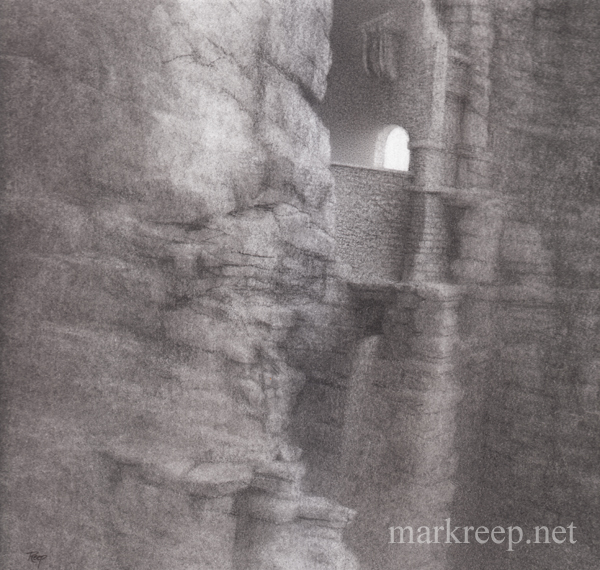
At the close of this session, elements above and below the little wood seem better integrated, and I like the height and flow of the columns at left. I eliminated a stand-alone column I couldn’t make work in the last session, and deepened the darks in that area to feature a new outcropping topped with an evergreen.
Whether I can make a given element work is another indicator whose worth I weigh. I liked that stand-alone colum, but no shape I tried seemed satisfying. Each successive stage of a drawing is another draft, and I revise a lot. But sometimes, when nothing I try makes an element work, I need to discard it. Usually when I recognize that, reach for the Big Eraser, whatever I’ve given opportunity to happen instead comes much more easily, and complements its context better.
I haven’t kept track of time spent on this drawing, but the last two scans represent about twelve hours’ work.
Monday, May 13, 2013
Knowing When To Stop
A cold gray day, and a six-hour afternoon session. Separating larger masses- the stone columns, wooded slope- into individual outcroppings, ledges, trees. Looking to make each the best I can, while keeping its values and impact in line with the whole. Leaning back, viewing the drawing at distance makes needed adjustments apparent: Too-darks that need lightening, and vice versa. As always, half the trick's knowing when to stop.
Saturday, May 11, 2013
Small Choices
A late evening session, only a couple hours at the end of the day: You work when you can, and often those times are as productive as any. Tonight, no big decisions, but many small choices, developing detail along the benches and below, adjusting values. I'm happy with their cumulative effect, how the components I worked with tonight are evolving, beginning to separate, assert their own character, reveal what they'll contribute to the whole.
Friday, May 10, 2013
Trusting Fun
Wednesday, April 24, 2013
Our Failings Are Our Strengths
Looking at more compositional possibilities: Rotating the image a couple degrees clockwise to lessen the empty space at bottom left, and roughing in a new waterline.
I'd planned on refining the stand of trees, adding detail, shadows, etc. But this may be one of those times when the first take is as nearly as good as it's gonna get, or needs to. Doesn't happen often. As I've mentioned many times, I nearly always think I can make this or that element just that little bit better. And usually I can. But sometimes I do the drawing much more harm than good. The trick, as always, is knowing when to leave well enough alone. Why's that so hard. But hey. Our failings are our strengths.
If I worked digitally I'd just add another layer, experiment in that, and so on. At worst, no harm done. Good thing I don't. Endless possibilities, no risk of pushing the paper too far- I'd probably never finish anything.
Sunday, April 21, 2013
Small Mysteries
Back at this one after several days away. I try to work at least some whenever I can, but I also try to recognize those times when I lack the necessary energy and clarity to make good decisions. When I'll likely only waste time, and I may fuck up a perfectly good drawing.
The waterline I tried seemed forced, a pat response, unsatisfying resolution to the shapes above. Happily charcoal and graphite are forgiving. I like the way the stone forms emerge from this stand of trees. How the trees soften, obscure, make me want to see further into those openings.
For me, these kinds of places are small mysteries. I'm not looking for explanations, resolution: Mysteries resolved are no longer mysteries, and what fun is that. I want the work to offer- to me, and to viewers- opportunity to wonder, imagine. As a friend said, "to find our own stories." So when I want to see more and can't, that's a good thing.
Thursday, March 28, 2013
Inching Toward Consistency
Session 6. I'm continuing to explore, choose shapes that seem to complement their immediate context as well as the whole. I like the overall, but I likely need to let my hands go, get a little looser at bottom left. The tones are inching toward consistency. The white line at bottom right (drawn with one of my favorite tools, a sharp Sanford Tuff Stuff Eraser Stick, and a straightedge) marks what will be a waterline. Here's a closer look at the beginnings of the reflections there.
Tuesday, March 26, 2013
Always More After That
Session 5. Changes to the area at top left of this detail are subtle, but they solidify, add detail, smooth gradation. More could happen here. More can always happen. Always more after that. But at this point, I don't think anything needs to.
I sketch in-drawing by pulling shapes from the charcoal and graphite midtones with a sharp kneaded or stick eraser. Shapes are quick this way, and I don't get pencil marks/scorings that may be problematic later. The roughed-in bits at bottom center aren't there yet. Their shape and flow seem to work well with those at bottom right. But I expect they'll change.
Sunday, March 24, 2013
Shadow's Fall
Session 4. More detailwork. Areas of greatest contrast become focal points. The composition will continue to evolve, but at this stage, my eye's drawn here:
The shadow's fall may change again. I like the underside of this element, the layered charcoal darks deepening this recess, but at this magnification it's apparent the top isn't quite there yet. Maybe that's why the shadow's edge seems off. Those edges are always a focal point as well, an opportunity to lead the eye. I'll start here next time.
Saturday, March 23, 2013
The Next Small Thing
Session 3. I didn't have a lot of time or energy tonight, but you work when you can. Best, nights like this, to avoid big compositional or conceptual decisions, look for the next small thing that seems to need doing, go from there. Here's an enlarged detail of one area I worked on.
This is how I see the work through my magnifier. The darkened recess is HB charcoal pencil, sharpened with an emery board. Stipple, blend with a Q-Tip, repeat.
Wednesday, March 20, 2013
So Far, So Good

For me, most of the joy of drawing is in exploration and discovery, and my approach indulges this. I love detail, and I dive right in, developing small passages immediately, usually without any idea what their context will become. I really don't want to know yet- What fun would that be. But those first passages offer possibilities, directions, and I choose one, and see where that leads, and so on.
Admittedly, it's an utterly inefficient process. Sometimes No Planning doesn't work out so well. But so far, so good.
Tuesday, December 11, 2012
Cutting Room Floor

Below, an enlargement of the composition I settled on, cropped and finished. Actual size is 2 1/4" x 3 5/16". The original is available. If you're interested, email or message me.
Friday, February 24, 2012
Stop Trying To Make Sense
Saturday, February 04, 2012
No Dream's End
No Dream's End
Charcoal, Graphite; 6 ½” x 6 ¼”
Twenty years ago I composed photos as best I could in-camera, and that was that. If a story or poem didn’t work, I discarded it. Photoshop and Word have made editors of us all, and these days I’ve come to consider unfinished drawings raw material as well.
Opportunities to revise a work on paper are much more limited. Working digitally, you can save the original, save every variant you like. You can only push paper so far. Then, like it or not, you’re done. But charcoal and graphite are forgiving, and erasers are a wonderful thing. I saved one of my favorite drawings with sandpaper. It’s a last resort, it doesn’t work often. And I’m not saying which one.
When I’m burnt on a drawing, when I’ve lost interest or confidence, I shelve it, move on to another project. The longer a shelved piece sits, the better: When rediscovered, it’s fresh, found art. New possibilities are apparent. They may have little to do with the drawing’s beginnings, and little of the initial work may remain by the time a drawing’s completed.
This is true of those pieces whose development is uninterrupted as well. I don’t sketch and transfer; I don’t plan; I try everything in-drawing. What works stays, but abandoned explorations and attempts (sometimes, lots) are still layered in there too, and they contribute to the drawings’ depth.
If this sounds like my drawings are salvaged fuckups– Yep, absolutely. They say a good carpenter knows how to hide his mistakes. Mine are raw material, and I try to make something better of them.
Sunday, March 07, 2010
The Nightingale's Garden

The Nightingale's Garden
Charcoal, Graphite; 5" x 9"
A series of in-progress scans and comments on this drawing are the subject of today's post on WestEndTalk.
Friday, January 22, 2010
Chapel Bell

Chapel
3 ½”” x 2”, matted & framed to 7” x 5”
$450.00
It’s been awhile since I’ve worked this small and tight, and with
For me, the process of stippling is about adding a little, taking a little away, adding more. When a mark or area becomes too dark, I lighten it with a kneaded eraser shaped to a fine point- Essentially, stippling in the negative. Not quick work, but continuing to build up and adjust marks as needed creates layered surfaces with texture and depth.
The chapel’s roof and walls were created the same way. For the foreground evergreens I used a softer 6B General Charcoal pencil, lightening with a kneaded eraser, softening and blending with a Q-Tip, darkening again, definining further. The foreground wall, bushes and ground cover were established with charcoal pencils, refined with graphite. To create the effect of the farther trees receding into bright mist, I used only graphite pencils to keep values in those areas lighter. The trees’ shapes and mist, the lawn and path were refined and smoothed with kneaded erasers, progressively harder graphite pencils, finishing with a Staedtler 6H.
I began the drawing’s remaining background by loading a cotton ball with powdered charcoal, scrubbing off most of it on scrap paper, then applying what was left very lightly, barely brushing the paper. It’s a technique that borrows something from drybrush, creates a kind of dry wash that's not as smooth as watercolor, but provides a good foundation for a somewhat similar effect. I avoided the finished elements, and developed adjacent areas- along the chapel’s roofline, and at bottom left- with the Staedtler 6H.
And yes, I did remember to use my magnifier this time.
The thumbnail above should load an actual-size jpeg at most browser settings. Here's an enlargement.

Chapel Bell and other recent Mark Reep drawings will be available at West End Gallery’s Little Gems exhibit. The show runs from February 5- March 12; opening reception is Friday, February 5, 5:00- 7:30. If you're interested, call Lin, Hedy or Bridget at 607.936.2011.
Crossposted to West End Gallery's new blog WestEndTalk.
Monday, November 16, 2009
Outfall

Outfall
Charcoal; 7 1/2" x 11 1/2"
I've wanted to work like this for awhile. Less finished, more suggested- More room, you could say, to dream. Sounds easy, doesn't it: Just loosen up.
Flash links:
E. K. Entrada's Morris Sees A Furrier: A Love Story, Keyhole Magazine
Pamela Painter's Office At Night, Smokelong Quarterly
Monday, November 02, 2009
No Sorrowful Way
Wednesday, October 07, 2009
At The Drawing Table

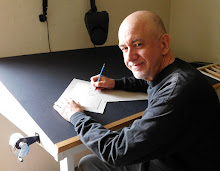
Fall housecleaning today- too windy to do much outside- and dustfree, the drawing table looked so good I grabbed a shot. Handheld and a little blurry, but.
I built this table while recovering from a heart attack in the fall of 2001. I can still remember how good it felt to get back in my shop again, to be doing something, however little, however carefully. Some days, you know you're not on top of it, better stay away from the table saw. All good now, and good to remember, to be grateful for where I am today.
In the years since, I've spent countless hours working at this table, and for the most part, it's held up well. The wall's messed up from all the stuff I've stuck up and taken down; I don't like to look at anything- my own work included- for long. Today, two things went into the wastebasket- A scrap of paper with the words Old North Road; and scrawled in charcoal on a strip of cardboard: It's never that I can't draw anymore. I just can't draw THIS, TODAY. I can still relate, but I wasn't in a can't frame of mind today, I was in housecleaning mode, and it went.