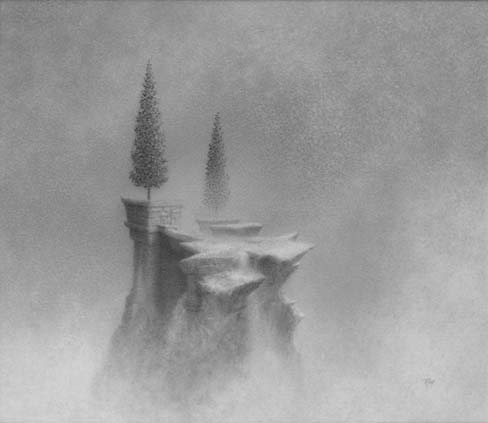
Rain Tern Waterworks, Year Unknown
Charcoal, Graphite; 3 7/8" x 5 1/8"
Here's the finished drawing. The jpeg above is posted at about the drawing's actual size; click on the image to see an enlargement.


The drawing’s overall range of values hasn’t changed significantly; this scan seems a bit better representation of the original. I’m happier now with the waterfall at top left, and the adjacent elements have been fun.

Here, it’s been about three weeks since I began this drawing, and a week since the last scan. Sometimes, my drawings develop in a way that seems fairly consistent, linear. With others, though, especially more complex projects that have already come to represent a considerable investment of time and work, I find I may need to take a break, let the piece set for awhile. Tired eyes, tired decisions, that I-just-want-this-thing-done stage sometimes seem inevitable. But over the years, I’ve gotten at least a little better at recognizing those times when I really, really need to not work on this right now.
I took a few days off from this piece, and I’m glad I did. The waterfall at top left needs work, but I like the elements to the right a lot. There’s a ways to go yet, but most of the composition has come into focus. Most importantly, I’m not thinking in terms of simply finishing the drawing. I’m having fun again, and I’m in no hurry.

“Atop the near gatehouse, someone has repaired the low walls of the little terrace, and a small, well-tended tree- an apple, or perhaps a hawthorn- is in bloom.”
The gatehouse, terrace, and tree are nearly done; the surrounding mist needs a little more work. Time to sharpen my No. 4 pencils again.

The near gatehouse, dam and walkway are coming into focus. Here, I’m using harder HB charcoal pencils to define the doorway, other shapes, shadowed recesses, the walkway’s sides.
I’ve begun cleaning up, filling, evening the mist with graphite pencil and kneaded eraser; the walkway’s right edge is nearly defined, and the mist in the lower basin is smoothing out too. For more on this process, see my article Creating A Misty Moonrise in Graphite and Charcoal.

Here I’ve developed the breakaway section further, defined the gatehouses’ shapes and relationship a bit more clearly, and established the waterfall between with a kneaded eraser.
Waterfalls’ brightest highlights are usually found at the top, where the water spills over the surface and edge it’s falling from. I usually establish that edge first, then work my way downward, trying to mimic the flow and direction of the arcs and paths the water follows as it falls.
If I lighten an area too much, or a highlight needs to be moved, I’ll use a Q-Tip loaded with charcoal dust to darken the area again as needed, then reestablish highlights with an eraser. To create or adjust midtones like these, I don’t leave the Q-Tip fully loaded with dust; the result would be too dark- Much or most of the dust gets rubbed off onto scrap before I apply the remainder (carefully) to the drawing.

Here I sketched with another eraser, a Sanford Tuff Stuff stick eraser. For anyone who’s not used one, it looks and works like a spring-loaded ballpoint pen; the eraser stick advances with each click. I sharpen the eraser to a fine point with an emery board.
This is a great tool for drawing in the negative, and for lightening and correcting small stubborn areas where a broader hard eraser would damage surrounding elements.

The ‘Big picture first, details later’ rule has never worked well for me- Probably because it’s never seemed much fun. Though a more exploratory approach has its limitations and downsides too, I’d much rather begin with an interesting passage, and see where that leads.
Here, as usual, I’ve immediately begun developing detail: Deepening shadows with a 6B charcoal pencil, softening them with a Q-Tip; using a sharply pointed kneaded eraser to define shapes. The cleaner the eraser’s point, the brighter the highlights it will lift out, so for prominent highlights like the breakaway section’s edges and corners, I reshape the kneaded eraser often to maintain a relatively clean point. A dirtier point works well for the tones like the breakaway’s top.

Here's a step-by-step look at the progress of my Rain Tern Waterworks drawing. Click on any jpeg for an enlargement.
Whenever possible, I don’t do much sketching before I begin a drawing- I’d rather sketch on the fly, exploring options, fleshing them out, revising, refining as I go.
Initially, I sketch with a kneaded eraser, lifting shapes from a gray background of charcoal dust. Elements established this way are more easily revised than if I’d drawn them with a pencil, and highlights that work well need less cleaning up than if they’d been defined by a pencil line at their brightest edge.
In the scan above, I’ve begun laying in darks with a soft charcoal pencil, blending tones, softening texture with a Q-Tip.

Sometimes I’m ready to commit confidently to a next step even though I have no idea where it may lead. Other times, though, not so much- And I’ve learned to listen a little more closely to that still, small voice that says, Don’t.
Several of my recent drawings are featured in Little Gems: A Collection of Miniature Paintings, at
Thanks to Philippe Mouchel at Le Mur de Pan online for the post on my work. I speak very little French, so I’ve been using translators to explore Philippe’s blog, which includes an online updating, with both reworked and new material, of his three-volume print comic of the same name. Though the translators don't help with the text in the strips, the imagery speaks for itself. His characters are charming, his environments rich, beautifully drawn, with dramatic use of light and shadow- Moody, mysterious, intriguing, inspiring. Looking at Philippe's work makes makes me want to go draw something, now.
Speaking of translations- For anyone who’s interested, Robert Couffy at Art-Galerie de Chahaignes translated an article I wrote awhile ago into French; it’s posted here.
Often, when I’ve struggled, I’ve fallen back on the assumption that my skills aren’t up to the task- Or simply, for whatever combination of reasons, not up to this task, today. Maybe I’m tired, not at my best, etc. That’s okay; tomorrow I’ll be better. There are times to push through difficulties, overcome challenges; and there are times to Stop Now, give the drawing a rest.
But lately, I’m trying to keep this in mind, too: If I’ve given an element of a drawing my best shot, just can’t seem to make it work, there may be another reason. What I’m struggling to make happen may not be the best choice, won’t (even if I pull it off) serve the drawing well. No new notion, and obviously not applicable to every difficult passage that comes along- Most are simply another challenge to meet, learn from. But sometimes, too, a problem may lie not with my skills, but my choices.


Waking
Charcoal, Graphite; 4 3/8” x 7 3/8”
This drawing’s progress, like the last, happened in two stages: The stonework and tree are mostly charcoal, and took two or three sessions; the water, mist, sky are mostly graphite pencil, and took several more.
I like old places. Places where time has softened edges, blurred lines: What was found, what was made? What was this place, or what was it a part of?
Ask a relic hunter, adrift across a long night of strange stars, useless charts scattered about his ship’s wheel- Squinting into brightening mist, stirred, just now, by the morning’s first breezes, and parting: He might know, might recognize the find of a lifetime. Or he might only guess, or imagine, or wonder, much as I do.
Ask a dreamer, nearing the end of her long night’s journey across that sea, or another, or many, all whose names are Mystery- A dreamer who feels, just now, the warmth of morning’s first sunlight on her face: For a moment, she may remember this place, call it by another name. But ask quickly, before she wakes fully, forgets.
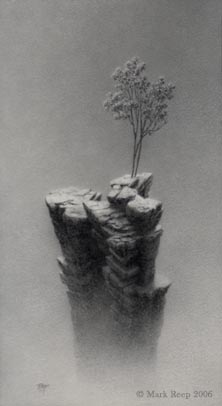
I’ve been drawing these kinds of spiky formations for years- I don’t ever seem to get tired of them. I like their solitude, their strength, their delicacy. I like the sense of enclosure and intimacy of this drawing’s mist; and I like the clean, spare, quiet composition that resulted. I’m continuing, I think, to learn how to better capture and describe these kinds of places. And I don’t imagine I’ll stop dreaming, exploring them anytime soon.
This drawing developed in two stages: The formation and trees took two or three sessions; the mist took a few more. I didn’t note working times, but I finished the drawing in a little over a week. Ideally, I’d like to spend more time exploring, less time refining. But bringing a drawing to the level of finish and consistency I want usually requires at least a few hours of slow patient smoothing and polishing.
Most of said smoothing and polishing was done here with graphite pencil; there’s more graphite in this one than most I’ve done lately. The formation and trees are charcoal, but the mist is mostly graphite pencil work- Dixon Ticonderoga pencils, grades 1, 2, 2.5, 3, and 4.

At 6 1/4" x 10 ¼”, Abandoned Waterworks is one of the largest drawings I've done to date. I didn't keep track of hours, but this one took ten days or so- Including at least a couple sessions spent working up, smoothing out the mist at the bottom.
I like mist I can see into, and the best way I’ve found to achieve transparence and depth is by building it up slowly, with many layers. I begin with a light layer of charcoal dust, lighten too-dark areas with a kneaded eraser; repeat the process; at the last, I’m using my hardest pencils to add very small marks and dots, and a dirty eraser shaped to a fine point to lighten or remove them.
Admittedly, a labor-intensive approach- But there are times when it’s the right kind of work for a couple hours. And usually, the results seem well worthwhile.
I don’t sketch much. Or rather, I don’t do much sketching before I begin a drawing- I’d much rather sketch on the fly, exploring options, fleshing them out, revising, refining as I go. I want exploration and discovery to remain an ongoing part of the process; I want the drawing to remain an adventure throughout.
Initially, I sketch with a kneaded eraser, lifting shapes from a gray background of charcoal dust. Elements established this way are more easily revised than if I’d drawn them with a pencil, and highlights that work well need less cleaning up than if they’d been defined by a pencil line at their brightest edge.
As the drawing progresses, I lay in darks with soft charcoal pencils, then blend tones, soften textures with Q-Tips. Lift out more highlights with a kneaded eraser, add deeper darks, sharpen edges, blend to further adjust tones, textures, contrast. Repeat the process, continuing to refine, revise, explore whatever suggests itself next.
The work develops its own rhythm, momentum. Sometimes, I’m unwilling to take even a moment to put down one tool, reach for another; and I’ll block in the next element’s shape with the pencil I have in my hand, lighten it later as needed.
Of course, not everything I try works. Far from it- And if it did, what fun would that be? Happily, charcoal is a forgiving medium. Most tones can be altered; most marks are removable, more or less- Usually, I can revise or remove anything that bothers me. And I’ve come to realize that where traces of abandoned directions remain, the drawing’s various textures benefit from the added depth and richness these underlying layers have contributed.
“The farther in you go, the bigger it gets.”
- John Crowley, Little, Big
For awhile now, many of my drawings have evolved in what’s become a fairly predictable way: Growing first larger, then smaller again as I explore possibilities, discard those that don’t work.
Editing has always played a large part in my process. I like cropping, exploring ways to clean up, strengthen, focus a composition. I want the result to be at once comfortable and arresting to my eye; every element should contribute, none detract.
The drawings continue to evolve as usual, through exploration and discovery, trial and error. But I’m finding that I’m retaining more of what I’m reaching for, and more of the drawings’ interim stages remain in the finished image. Still editing judiciously- I don’t imagine I’ll ever stop working that way.
But then, that’s another of my goals: I want to imagine more, and in lots of ways. For one, I want to continue to sketch things I can’t wholly capture, bring to a level of finish that satisfies me- Yet. Hopefully, my reach will always exceed my grasp, my aspirations exceed my skills.
The more I reach for, the more I find; and in trying to capture more of what I can only glimpse at the moment, I continue to learn: How to work more efficiently; how to trust that part of me that understands more than my intellect about what I’m trying for. How to avoid habitual responses; how to further, instead, the flow of what’s happening.
Every now and then, I realize that I’ve gotten a lot better at something I’ve been working to learn, that I’ve reached some goal I’d set for myself awhile ago. Usually comes as a pleasant surprise, and I marvel at this a little.
And then I get back to work, and begin again.